November 03, 2006

A Birthday Sonnet


Tomorrows, a pursuit permanent
a future filed, so to say
also pathetically contingent
on tortuous toils of today

bundle of joy and priceless gain,
posterity held so tight
an aftermath of perilous pain
bravely borne many a night

fall foliage,a poet's cue
the plush palette of a painter
gold red and orange richly hued
do but follow a bygone summer

relentless this striving
a Sisyphus calling

October 30, 2006

"Tsotsie" and "The Little Terrorist"


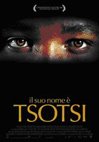
Tsotsie, the movie, reinforces faith in man's goodness. The worst of us and the worst within us can always be negated and wiped out by the good that's inherent within all of us, if only we'd let it surface. Tsotsie, the protagonist in the movie, is a confirmed 'thug' of Johannesburg who whips out knives and guns at the batting of an eye. However, toward the middle of the movie he is a transformed being; thanks to a surprise guest who lets flow 'the milk of human kindness' in Tsotsie and establishes a lifelong relationship between them, with no strings attached. Joseph Conrad's Kurt bared every man's Heart of Darkness and made humanity shudder. Athol Fugard's Tsotsie rekindles every man's faith in his innate goodness and makes humanity proud and worthy.

The film won the Oscar for Best Foreign Language Film in 2006 with brilliant acting by the South African actor Presley Chweneyagae as Tsotsi. It is based on Athol Fugard's novel of the same title that was written a few decades ago. What is interesting is that both the writer Athol Fugard, who created the character Tsotsi, and the director Gavin Hood, who read and presented Tsotsi, are white Afrikaans. With no racially divisive agenda in mind, and with an admittedly limited knowledge of the current racial dynamics in South Africa, I find myself speculating on how and if Tsotsie, the movie, would have been different if it were a black African's creation and presentation.

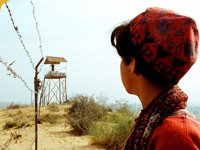
Coincidentally, I also happened to have watched another foreign film "The Little Terrorist" (watch it here) made by an Indian film maker, Ashvin Kumar. A ten minute film based on a true incident that happened on the India-Pakistan border, The Little Terrorist was nominated for the Oscar in the Best Short Film, Live Action category in 2005. Though different from Tsotsie in many ways, The Little Terrorist has a similar theme that reaffirms and reinforces the good in man; and holds the promise of a fledgling hope for humanity.

Both films are definitely worth viewing.

October 29, 2006

'Fall'


Is ‘the Fall’
'a fall'?
a fiery falling blanket
enveloping the tired greens
a carrier of crisper winds
rustling the fallen leaves
a harbinger of felling logs
preparing for the winter
a getaway for fallen leaders
electioning in a change.

'The Fall', a changer of seasons,
from summer to December.
A temperer of spirits
that dampen to winter.

Is ‘the Fall’ ‘a fall’?
Not really after all.
It lays to rest
a lonely nest.
Till it’s time again,
at nature’s behest,
for birds to listen
and leaves to glisten’
for streams to flow
and daffodils to show.

A gentle intermediary;
'The Fall’s' but a step between.
For man’s hope and nature’s repose
A see-through kindred screen.

Mitch Albom's "For One More Day"


'Father-bashing over two generations', pretty much sums up Mitch Albom's most recent tear-jerker "For One More Day".

One of those 'let-me-be-your-counsellor' kind of novel, "For One More Day" starts off really well where Charley the main protagonist decides he wants an out of his lack-lustre life where he's failed as a son, as a husband, and as a father. However, he's unable to do even that; his suicide attempt fails! What happens next is an out-of-the-world experience where a comatose Charley establishes communication with his long dead mother; a mother he 'didn't ever stand up for'. From this point on the novel is all downhill. A set of contrived situations to showcase the sheer selflessness of motherhood against an apathetic father figure telling a young Charley "You can be a mama's boy or a daddy's boy, but you can't be both."

It took me a long time to figure out my response to the novel; primarily due to a sense of guilt for not liking what Albom presented; perhaps because at some level it did pertain to me, and to Everyman. All of us have some cleansing to do; to rid ourselves of those ghosts from our past that seem to haunt us; and here was this novel doing just that, and yet I could not readily say that I liked it. The cloying sentimentality and the not-so-surreal situations made it distant, and I could not lose myself in it; I could not suspend my disbelief.

If "Tuesdays with Morrie" is what made you pick up this novel, you are bound to be disappointed.

October 17, 2006

'The War Within'


Ayad Akhtar's movie 'The War Within' is a sensitive portrayal of Pakistanis living abroad in a post 9/11 world. The story revolves around a young Pakistani engineer studying in France whose life of normalcy comes to a screeching halt the day he's picked up as a suspect by American Intelligence and taken back to his native country, Pakistan, for interrogation. What follows is a heart rending, at times excruciatingly violent and graphic, depiction of how this normal protagonist is driven to near-lunacy and fanaticism.

A thought provoking film no doubt, but oftentimes logic-defying. For instance, how does a person just disappear off the radar for an extended period of time without anyone, not even his family, making inquiries about him? Akhtar, while trying to project the plight of ordinary immigrant Pakistanis, does get a little carried away in that he demonizes various American organizations that are but doing their duty. The USA Police is one such victim; they are presented as a bunch of non-thinking individuals who are blatantly racist. However, while dealing with the 9 year old Pakistani boy Akhtar has excelled. He's done a splendid job of capturing the impact of terrorism and its aftermath on this young mind. The viewer, regardless of his affiliations, is affronted at the quick and cruel end, almost a snatching away, of the boy's childhood.

It is said that an artistic creation usually carries a message, and I wondered about the message in "The War Within". Does it transcend the barriers of color, religion, and race, or is the message relegated to the perpetrators and the victims of 9/11? Does Akhtar's movie condone what the protagonist did? Is a terrorist born, or is he made? Who or what facilitates the making of one? I have not been able to find any clear-cut answers to any of these questions, but watching the movie I got the impression that Akhtar had.

September 30, 2006

Noam Chomsky - "Imperial Ambitions"


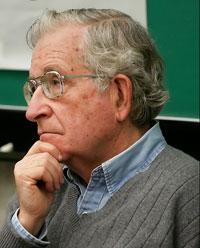
Noam Chomsky's popularity has risen ever since Hugo Chavez recently held up Chomsky's book Hegemony and Survival as a must-read, both after and before his speech at the United Nations. Chomsky, a highly respected linguist and philosopher from MIT, admits to his dual vocations, that of a teacher and researcher and the other lesser known one of a social activist. There are some things that make him unique. Firstly, being Jewish he has taken some strong stands against Israel's policy in the Middle East. Secondly, inspite of some fifty odd years of vocal social activism as an ultra liberal, he has no consistent political theory to propound like Samuel Huntingdon and Bernard Lewis. Finally, his popularity with die hard democrats does not spare them of his criticsm; he is just as critical of the Clintons and Kerrys of the world.

I just finished reading the book "Imperial Ambitions" where David Barsamain has Chomsky speak about the future of Social Security, the imminent threat of global warming, and mostly about the volatile situation developing in the world due to United States' intervention in Iraq. Chomsky is bold, honest, upbeat, witty and most of all alarmingly well informed in matters of global policy for a philosopher linguist. As a result he spins this web of persuasive dialectic for a disarmed reader and will not let him out, but convinced. He both informs and cautions the American public against government propaganda that works by making its citizens afraid; a tactic that he points out has been used by various American Presidents to allow them to carry out there imperialistic agendas. The one instance he gives of President Reagan's justification for the US war in Nicaragua, and then links it up with the current situation in Iraq and the Middle East, is particularly brilliant:

"On May 1, 1985 Reagan declared a national emergency in the United States because of the threat to the security of the United States posed by the government of Nicaragua, which was a two days’ drive through – I would note – at least one other country, Mexico, many times its size, from Harlingen, Texas, and Nicaragua was planning to take over the hemisphere! If you take a look at that Executive Order, which was renewed annually as a way of building up support for the U.S. war in Nicaragua, it has almost the same wording as the 2002 congressional declaration on Iraq. Just replace Nicaragua with Iraq...How much critical thinking and analysis does it take to determine how much of a direct security threat Afghanistan, Iraq, Iran, Syria and so forth are to a country that possesses the most powerful military in the history of the world, is bounded by two vast oceans and is bordered by two very peaceful neighbors?"

Chomsky can grow on you without you knowing, and that makes him worrisome. I have great respect and admiration for Chomsky, the eminent linguist who has made many significant contributions in the field of language aquisition. However, I am a little wary of his political writings because they have the word-power to sway a naive populace. No wonder The New York Times has called him “arguably the most important intellectual alive”, and The Guardian declared: “Chomsky ranks with Marx, Shakespeare, and the Bible as one of the ten most quoted sources in the humanities—and is the only writer among them still alive.”

September 26, 2006

Eran Riklis's "The Syrian Bride"


A movie that lays bare what a broken world does to human relationships. Eran Riklis's movie brings together an Israeli- Palestinian crew to take us to one of the most controversial geographic locations on the globe, Golan Heights. A place where national boundaries become shards that cut up peoples lives into shreds and every part seems to be moaning the other.

"Mona's wedding day may be the saddest day of her life" is how the movie begins. The rest of the movie goes about showing how that happens in Golan Heights, a part of Syria that is 'occupied' by Israel. The people living there are the 'Druze', a monotheistic people who follow an early offshoot of Islam, and who reside primarily in Lebanon, although there are smaller communities in Israel, Syria, and Jordan. Mona is the Syrian Bride who lives in Golan Heights and is to marry a famous television artist from Damascus. The two have never met, and when they do it is across a barbed wire fence and a checkpost manned by some unique personalities. Two ineffective and helpless United Nations personnel add to the motley crew at the checkpost where Mona is to meet her fiance and leave her family and home forever to go to Syria.

This momentuous event brings Mona's immediate family, her estranged brother and his Russian wife, her other brother, Marwan, of the dubious reputation, Amal her 'rebel' sister with her ultra-conservative husband to Golan Heights; all under one roof despite their differences. The house is a microcosmic representation of the unrest that prevails in the Middle East. The suspicions, the rumours, the petty differences, the attacks, the defences, and the temporary truces within those walls expose the fractured relationships within a family and also those within an entire region.

A thought-provoking and informative foreign film.

September 22, 2006

Noble is What Noble Does

Anand Kumar does the profession proud! All is not lost; teachers such as he provide hope for our future generations.