January 07, 2007

Ivy League Professors Undermining Education?


Should professors be good teachers? In Universities and colleges across the United States research always takes precedence over teaching so much that a well published professor does not really care about his performance as a teacher and simply concentrates on producing cutting edge research. Understandably so because cutting edge research brings in money and fame both to the academician and to his university, but at a cost. At the cost of permanently thwarting and stunting bright and fertile minds poised on the brink of academic and scientific breakthroughs.

A freshman in a college of some decent standing is but waiting for that slight prod, a nudge in the right direction, a word of encouragement from a renowned entity, to set off into a world of discovery and exploration, that if brought to fruition could impact humanity for centuries. Alas, that is not happening in many of our prestigious colleges and universities. Ivy League Universities for instance have Field Medalists and Nobel Laureates teaching undergraduate classes. These individuals are star attractions for a student wanting to study at that university; who wouldn't want a Toni Morrison, or an Andrew Wiles, or an Orhan Pamuk as a teacher! However, this euphoria is short lived; the starry-eyed student walks into his first lecture class to find another fifty students, like him, all agog to be taught by the eminent personality. That is but the first disappointment, and also the least painful. By the time this student is into the second lecture he figures out that the professor is really not interested in teaching, and is in the room going through the motions of presenting information, and would do the same if there were fifty empty chairs facing him instead of the fifty focused faces that eagerly await the words that are yet to come out of his mouth. Nonchalantly and with the ease of a maestro, he presents his piece as he sees fit and presumes you understand it because, after all, you did make the cut to get into an Ivy League, then you opted to be in his class, and finally there is always the option of switching to another class, another major, another university, or then dropping out for the semester.

The Professor of course is oblivious of the struggling students' predicament as also to the 'i + 1' teaching model. He does not care that the students coming out of high school come with a limited data base of knowledge ( i ), and as a good teacher he has to present his content using the ' i + 1' strategy so that the students start with what is familiar to them (the 'i') and then build upon it as they go along. They have some firm ground to stand on before they venture into the next/higher level of knowledge. In complete disregard of the needs of his students and in spite of his own displeasure, the 'star' professor proceeds to lecture the class, wincing at any interruptions. He has his Ph.D students conduct tutorial sessions apparently to offer help in doing the complex assignments he gives at the end of each lecture, but more likely to appease his own conscience that berates him for his neglect of duty as a teacher. Of course, he finally hands out the much dreaded exam at the end of the course for the few students, who out of sheer resilience, did not drop out of his course despite his apathy.

These killing 'Ivy' fields are sounding the death knell for academic excellence. What is the above but a slow and sure thwarting of a brilliant young mind unkindly reproached, obviously and repeatedly ignored by those in position of power. It is an intimidation and a consequent subduing of young scholarly minds by those deemed intellectually superior because of their publications and awards. In places such as Princeton and Harvard this is a common scenario, but one that is seldom talked about and almost never written about. It's a disgrace that renowned places of learning such as these are guilty of stunting and amputating minds for no other reason but that these minds are mere learners in an environment charged with academic brilliance and home to Nobel Laureates and Field Medalists who, unfortunately, believe that the benefits of research outweigh the benefits of educating the human mind.

December 29, 2006

Little Miss Sunshine

What a bit of sunshine can do in the most hopeless of situations!

A hilarious tragic-comedy that'll have you in splits while it breaks your heart. Situational humor that makes you forget the dysfunctionality of the family within which it happens. A streak of stray sunshine that momentarily obliterates the bleakness that surrounds a family ready to fall apart; parents on the brink of a divorce, a delusional father but a step away from bankruptcy, an overwhelmed mother who's recently been burdened with her thirty year old brother who is gay and suicidal, a war veteran grandfather who is obsessed with sex, a teenage son who has muted himself and lies buried in Nietzche while forced to share a room with the suicidal uncle. The only redeeming feature is Olive, the 9 year old, whose hundred watt smile could brighten a universe. She is competing in the final rounds of the "Little Miss Sunshine" beauty pageant that she is destined to lose because of her obvious little paunch; a result of her love for 'good food'!

I'm embarrassed to label the movie a comedy; even apologetic for finding it funny. The humor depicted was at the cost of a family's happiness; something I completely disregarded or was oblivious to, while reeling under peels of laughter in the movie hall. The fact I could do that, says a lot about how akin we are with situations such as those presented in the movie. I wonder if that is a statement on the society we live in? Are we to understand that dysfunctionality within a family is quite the norm? That we can calmly pass it by, even ignore it, and then go a step beyond to find humor in the bizarre situations that it creates? The next question that comes to mind is about the writer's intent. Was he holding up a mirror to society and smirking when he saw his audience laugh? Or else, like the rest of us, he's developed an immunity to this dysfunctionality that exists, and can now create humor, even while family values are being trampled on.

A must see for anyone who appreciates low key 'n top quality humor, rendered by some fine actors in unique situations that speak volumes for the storytellers creativity.

Blogger Upgrade Problems


I've switched to the new Blogger version, and as expected there are some surprises; I find many of the comments on my posts are now titled 'anonymous' that earlier carried a name! This may be due to a variety of reasons, and I apologize for any communication exigencies that may occur as a result.


December 19, 2006

'Blood Diamond'


Sierra Leone's bloody civil war of the late 90's is captured by this action packed thriller, "Blood Diamond", starring Leonardo DiCaprio and the Beninese actor Djimon Hinsou of the "Amistad" fame. Perhaps the United Nations can set up a partnership with Hollywood for catching public attention and raising public awareness about issues that plague our world today; Sierra Leone, Darfur, Afghanistan, Colombia. This movie successfully brings out the issue of illegal diamond mining in Sierra Leone and the illicit sale of diamonds thereof. The pathetic plight of the exploited diamond mine workers is whipped to the forefront by Zwick's thriller. No individual having watched this movie would be able to buy a diamond without wondering whether it is a 'conflict diamond'! It may be wishful thinking on my part but possibly the Diamond District in New York may have taken a temporary hit because of this movie. Couples wanting to get engaged may, for the time being, have been guilted out of buying that diamond ring!

Illicit diamond mining has been a major issue at various global conferences these past few years, yet, that hasn’t affected diamond sales in any significant way. Primarily for two reasons: one that global issues such as these seldom break the confines of the conference sites or the tenement of an exclusive bureacracy to reach the common man. The other reason is that the social conscience of most human beings is very easily appeased by words: “the diamond I buy is not a ‘conflict diamond’”, " I made sure I did not buy a diamond from Sierra Leone". These consolatory words do two things: placate a stirring conscience back into apathy, and convince the buyer to go ahead and write the check to get ownership of a diamond. If anything, movies like 'Blood Diamond' could only affect how diamonds get marketed to the general public henceforth. For instance Tiffany could market its diamonds using a different line: “flash it without guilt”, ‘your diamond, your conscience keeper’, and other such euphemisms.

Statistics show that Americans are prolific diamond buyers, and knowingly or otherwise may have sparked off and sustained many vicious wars in places such as Sierra Leone. Movies such as “Blood Diamond”, therefore, may raise public awareness of global issues in the American public, but whether it’ll bring about a change in the life of those exploited workers in Sierra Leone is debatable.

A trifle violent and at times gory, 'Blood Diamond' is definitely worth watching, if only to nudge us out of our complacency.

December 11, 2006

Harry Frankfurt's 'On Bullshit'. A definition, a defense, or dizzy dialectic?


The title "On Bullshit" is no doubt an eyecatcher, as is the compactness of the book: a 67 page 7"x5" book; the single reason I picked it up. As they say, appearances are often deceptive, and this one surely was. The 67 page book is a piece of dense non-fiction that took me over three hours to read and another some to comprehend. Every page is dialectic so coherent, so convincing that the reader, manacled in argument, is lead into a maze where the only way out is to suspend disbelief and go where the author leads you.

The term 'bullshit' is not merely a reference to a British expletive but also to an activity that millions of us, world over, are engrossed in. Harry Frankfurt, after admitting that 'bullshit' is a British coinage, goes on to define bullshit in many creative ways: 'humbug','hot air', a male cow's 'corpse of nourishment', and many such more. That's when the reader wonders why he's reading an entire treatise about something that is 'short of lying', is an irreverent and colloquial usage, and is as hard core British as 'bull shit'. At this point in the book the author may very well lose his reader who might choose to abandon the book for its lack of real substance. Well Frankfurt didn't lose me. Not so much because of his creativity at defining bullshit, or his defense of it thereof; it was because I needed to find out the relevance of 'bullshit'. I was piqued by the newly established importance of 'bullshit' that makes a professor at Princeton say "although it (bullshit) is produced without concern with the truth, it need not be false". Having said that, the reputed professor then decides to write an entire book about it.

Whether Frankfurt's "On Bullshit" is able to give 'bullshit' its rightful meaning and place in our world, is not immediately discernible. However, it's interesting that Frankfurt chose to write a sequel to this book soon after, and titled it "On Truth".

The 'Truth' is out there somewhere, and I must pause till it comes to me.

November 22, 2006

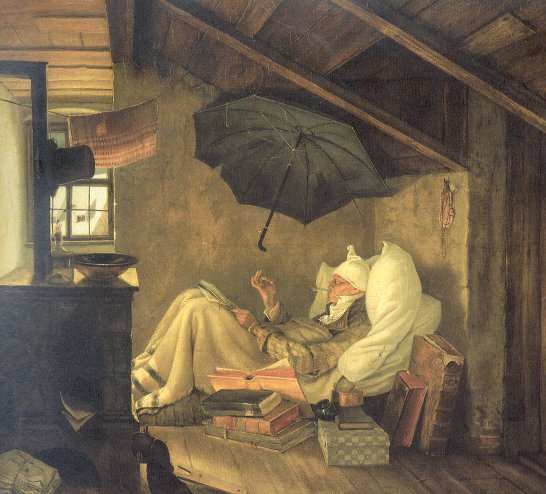
The Poet


Spitzweg

Million muses fail to inspire
the apathetic soul of doused desires.
Seldom can I dare in ink
the passionate thoughts I used to think.
Mute though I am today,
comfortably a no one;
not venturing much to say.
Will I find it in me
to be a voice one day?

November 17, 2006

Cops Taser Iranian American Student in UCLA

Would the treatment meted out to the student at UCLA have been different were he not a 'foreigner'. An Iranian American student was forcibly taken out of a university premise by cops for not being able to provide a student ID. The live video on this link brings to mind the Vietnam War protests of the yesteryears.The same video can be seen via 'you tube' on Sharique's post where I first saw it.

Update:
1.The University of California Police Department had this to say about the incident.

2.There was a protest at UCLA yesterday at noon, and there's one scheduled at UC Berkeley at noontime this coming Tuesday. The National Iranian American Council is protesting vociferously to the UCLA Chancellor, Mayor of LA, and the UCLA Chief of Police against this incident.

November 09, 2006

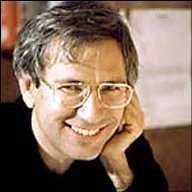
Nobel Laureate Orhan Pamuk's "Snow"


Pamuk comes in highly recommended, besides being the most recent Nobel Prize winner for Literature. He was on my to-read list for over a year, but it was only after his novel "Snow" was singled out for recognition did I finally get down to reading him. This may have something to do with the fact that he writes in Turkish, and therefore his novels are translations. Of recent, I have developed a mental block toward translated novels; Garcia Marquez's novel "Memories of my Melancholy Whores" being my first victim. Pamuk's Snow is yet another such translation; a novel I therefore picked with some reservations. Having decided to read it, I have to admit that it was quite the page-turner for the first hundred pages or so. When a novel starts off at that frenzied level of anticipation, it creates problems for itself; those of sustainability. The author has to now maintain the same level of excitement in the reader for the remainder of the novel. I'm not sure Pamuk succeeds in doing that in "Snow". The delirious excitement of the first few chapters subsides steadily into a figure-out-who-I-am session.

What really drew me into the story was its setting; Anatolia, a peninsula of Western Asia in Turkey which is part Asia and part Europe, the Asian part being the larger . The interplay of dynamic characters in an ethnically diasporic setting always makes for a unique reading experience; and "Snow" was that. The characters, so very different and yet displaying and experiencing universal human emotions of anger, jealousy, greed, and pride, makes the reader forget the geographic and ethnic borders that divide Turkey, a country that straddles between its secularist identity and its ancient Islamic heritage. In fact, at the very outset, the reader embarks on a journey that showcases this split. It is a journey that the reader takes on with the main protagonist Ka to his homeland Kars, a place from where Ka'd been exiled twelve years ago. Ka has now been invited by an old friend to report on a spate of suicides among young Muslim girls prevented from wearing headscarves in school.

Mentally taxing though at times, but the wide array of characters that Pamuk generates in the context of the story is remarkable, definitely a mark of a master story teller with a restless imagination. As Pamuk himself admits, "I have this urge to stop this life and start afresh," he says. "I am in a train, and the train goes into a town, or it passes close to houses. ... You see inside the house where a man, a family, a TV is on, they're sitting at a table. You see a life there. There's an immense impulse to be there, to be them, to be like them." That is exactly what he does in the novel; each character is unique with a life of its own that could well have been spun into another story, but Pamuk leaves you with but a taste, and wanting for more.

The evasive nature of the novel and its characters is reflective of Pamuk's own unwillingness to be pinned down, his restlessness at being unidimensional in his ethnic identity, his political views, or then his characters. For example, Pamuk's chief protagonist, Ka, is hard to hold on to. It is easier for the reader to be one with Ka's journey than with Ka himself. This inconsistency in Ka's character is like a dual edged sword that lends Ka, the poet, his credibility; yet, it also takes away from Ka because the reader is unable to empathize with him. It is this very dichotomy that Orhan, a friend of Ka in the novel (possibly the writer Pamuk himself) lays bare to reader scrutiny at the end of the novel. It's almost as if Pamuk wanted the reader to be the judge of what Pamuk had so vividly yet dipassionately presented in his story.

The reader comes away wondering whether this was but a cerebral merengue for a politically erudite brain or did Pamuk have a message to convey through the novel. Was Pamuk trying to promote Turkey's bid to join the European Union, a move Pamuk has openly supported? Or is he raising public awareness of the slow but sure insurgence of radical Islam into the Turkish psyche? Is he exploring the role of Art in a nation in the throes of political, economic, and religious turmoil? Or then, is it as the title suggests, a philosophic perspective on 'snow' wherein Pamuk studies the anatomy of a snowflake and develops it into a symbol such that, "Everyone has his own snowflake; individual existences might look identical from afar but to understand one's own eternally mysterious uniqueness, one has only to plot the mysteries of his or her own snowflake".